


Table of Contents
Understanding How Blind Children Perceive the World in India
A blind child perceives the world not through passive sight but through active, sequential exploration using sound, touch, smell, taste, and proprioception (body awareness). Unlike a sighted child who takes in a whole room instantly, a blind child builds a mental map piece by piece—hearing the pressure cooker whistle from the kitchen, feeling the coolness of a marble floor, smelling the turmeric from the neighbour’s cooking, and sensing the vibration of a passing auto-rickshaw.
In India, where the environment is dense with sensory information (loud traffic, strong spices, varied textures like jute and silk), parents can leverage this richness. The key is to understand that abstract concepts like “colour” have no direct sensory equivalent; instead, colour must be taught as a property linked to consistent tactile, thermal, gustatory, or emotional experiences.
How to Explain Colours Without Sight: A Parent’s Guide
| Step | Action | Example |
| 1 | Start with tangible objects, not abstract colour names. | Do not say “red.” Say “This is a ripe tomato. Ripe tomatoes feel smooth, round, and heavy. Their colour is called red.” |
| 2 | Use consistent multi-sensory pairings. | For Yellow: Pair a raw mango (sour taste, smooth hard texture), turmeric powder (bitter smell, fine powder), and a marigold flower (soft petals). Say “Yellow” for each. |
| 3 | Introduce temperature associations. | Blue: Place the child’s hand on a steel water bottle filled with ice water. “This cold feeling is like the colour blue.” Red: A warm cup of tea (not hot). “This warmth is like red.” |
| 4 | Link to emotions (social context). | “When your grandmother hugs you and you feel happy and safe, that feeling is like orange (the colour of her dupatta on festival days).” |
| 5 | Use sound mnemonics. | Green: Crush fresh mint or coriander leaves near the child’s ear (the crisp sound) then let them smell it. “The fresh, cool smell and crisp sound is green.” |
| 6 | Teach contrasts first. | Black vs. White: White rice (soft, sticky) vs. black urad dal (hard, small, dry). Dark vs. Light: Heavy velvet (dark) vs. light cotton (light). |
| 7 | Move from concrete to abstract. | Once “red” = tomato, then “red” = warm, strong, stop (traffic light signal on a phone app). Never skip the concrete step. |
Using Touch and Texture to Teach Colours Effectively
- Red:Rough brick, sandpaper, the bumpy skin of a pomegranate.
- Yellow:Soft silk dupatta, smooth lemon peel, fine turmeric powder on a plate.
- Green:Crinkly fresh leaf (tulsi or mint), velvet cloth, the smooth skin of a raw cucumber.
- Blue:Smooth, cold stainless steel, denim jeans fabric, the sleek surface of a plastic water jug.
- Orange:The pebbly skin of a kinnow (orange fruit), a soft woollen shawl, the slightly rough surface of a clay kulhad.
- Black:Hard, shiny plastic of a TV remote, smooth black granite stone, the soft felt of a school bag.
- White:Cotton ball (fluffy), soft curd rice (wet & sticky), smooth milk-soaked bread.
- Purple:The smooth, waxy skin of a brinjal (eggplant), a bunch of heavy grapes.
Relating Colours to Temperature, Taste, and Emotions
| Colour | Temperature | Taste (Indian foods) | Emotion / Feeling | Sensory Anchor |
| Red | Warm to hot (sun-heated roof, hot tea) | Spicy (red chutney), sweet (strawberry jam) | Anger, energy, love (Valentine’s Day, Holi red) | “Red is the heat of a matchstick and the anger when someone breaks your toy.” |
| Yellow | Mildly warm (room temperature ghee) | Sour (lemon pickle), sweet (mango pulp), bitter (turmeric) | Happiness, caution, intellect (Haldi ceremony) | “Yellow is the happy sour taste of a lemon and the smell of sunshine on a pillow.” |
| Green | Cool (shade of a tree, mint mouthwash) | Fresh (coriander chutney), bitter (karela), sour (raw mango) | Calm, jealousy, growth (nature, Eid green) | “Green is the cool breeze from the fridge and the fresh smell of cut grass.” |
| Blue | Cold (ice cream, fridge water) | Neutral to bland (blue is rare in Indian food – use blueberry or synthetic candy) | Sadness, calm, trust (Lord Krishna’s skin) | “Blue is the deep cold of a well and the sadness when you miss your friend.” |
| Orange | Warm (morning sun on face) | Sweet-sour (orange fruit), spicy (tandoori chicken) | Energy, celebration, warmth (saffron in flag, Diwali) | “Orange is the warmth of a campfire and the excitement before a gift.” |
| White | Cool (milk straight from fridge) | Mild, milky (doodh, dahi, khoya) | Peace, emptiness, purity (mourning in some cultures, new beginning) | “White is the soft, quiet feel of milk and the peace of an empty room.” |
| Black | Neutral to hot (asphalt in summer) | Bitter (black coffee, burnt toast) | Power, emptiness, mystery (Kali Puja, black car) | “Black is the silence of a closed room and the deep space when you close your eyes.” |
Simple Daily-Life Examples to Explain Colours at Home
- Morning Tea:“The dark brown liquid (like the colour of tree bark) is hot. Light brown sugar dissolves in it.”
- Washing Clothes:“Your white school shirt is now grey because it’s mixed with dark blue jeans. Feel the difference in cloth colour? White feels cleaner, blue feels rougher.”
- Vegetable Shopping: “This green chilli is small, smooth, and sharp-smelling. This red capsicum is large, waxy, and mild. Both are crunchy, but their ‘colour feeling’ is different.”
- Storage Containers:“Rice is in the yellow container (rough plastic). Dal is in the green container (smooth plastic). Always remember: rough = yellow, smooth = green.”
- Flooring:“The marble in the living room is cold and white (smooth). The mat in the pooja room is red (rough, woven).”
Teaching Colours Through Food: Indian Dishes as Learning Tools
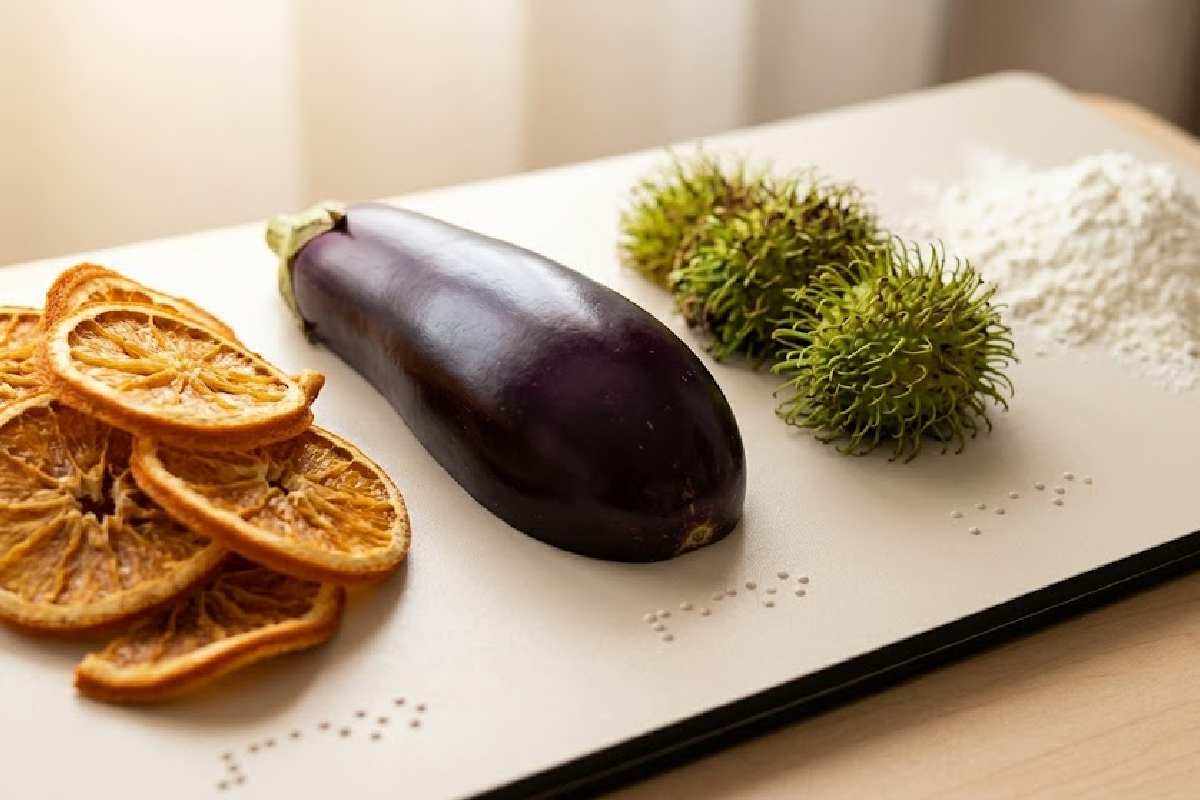
Food offers the most direct, non-visual pathway to colour because it involves taste, smell, texture, and temperature simultaneously. For a blind child, a meal is a colour palette. Begin with single-colour dishes: Yellow dal (toor dal with turmeric – smooth, earthy smell, mild taste).
Green hari chutney (coriander + mint – wet, grainy, pungent smell). Red tomato soup (warm, slightly sour, smooth). Then move to multi-colour dishes like biryani: teach that the white rice (soft, bland) contrasts with orange fried onions (crisp, sweet-smelling) and brown meat/paneer (chewy, salty). Always say the colour name before and after the child touches or tastes the food.
- White:Curd rice (cold, soft, sour). “White is calm and cool.”
- Yellow:Besan chilla (warm, soft, slightly bitter). “Yellow is breakfast energy.”
- Green:Palak paneer (warm, creamy, iron smell). “Green is strength.”
- Red:Watermelon (cold, wet, sweet, seeds feel like small pebbles). “Red is sweet fun.”
- Brown:Roti (warm, soft, earthy smell). “Brown is the ground beneath us.”
- Orange:Gajar ka halwa (hot, sticky, sweet, soft). “Orange is festival celebration.”
How Indian Festivals Can Help Explain Colours Creatively
| Festival | Colour Focus | Sensory Teaching Activity |
| Holi | All colours, especially Pink, Blue, Green | Fill spray bottles with water at different temperatures (slightly warm = pink, cool = green, ice cold = blue). Spray on child’s arm. “This cold wetness is blue. This warm wetness is pink.” Use scented gulal (rose = pink, jasmine = white). |
| Diwali | Orange (flames), Gold (sparklers), Red (rangoli powder) | Let child feel the heat of a diya (candle) from a safe distance. “That focused heat is orange.” Give them gold foil from sweets (crinkly, smooth). “The exciting crinkle is gold.” |
| Eid | Green (flags, clothes), White (new clothes, sewaiyan) | Give child green cardamom pods (rough, intensely fragrant). “The strong, special smell is green.” White sewaiyan (thin, dry, brittle). “The clean, dry feel is white.” |
| Pongal / Sankranti | Yellow (turmeric, sugarcane), Black (sesame seeds), Brown (jaggery) | Let child rub a turmeric stick on wet stone (creates gritty yellow paste). “The bright, bitter paste is yellow.” Black sesame seeds (tiny, many, rolling). “The small, scattered feeling is black.” |
| Ganesh Chaturthi | Red (flowers – hibiscus), Green (leaves), Yellow (modak dough) | Hibiscus flower (large, sticky, velvety). “The sticky, thick petal is red.” Modak dough (smooth, cool, pliable). “The soft, sweet dough is yellow.” |
| Onam | Green (banana leaf), White (rice), Orange (parippu curry) | Banana leaf (waxy, smooth, cool, large). “The big, cool mat you eat on is green.” |
Storytelling Techniques to Describe Colours to Visually Impaired Children
| Technique | How to Do It | Example |
| Sensory Metaphor | Replace visual adjectives with tactile/smell/sound ones. | “The red demon in the story had a voice like hot chilli powder – rough, burning, and loud.” |
| Object Journey | Take a single colour object through a story. | “A green mint leaf fell into a pond (cold, wet). A cow ate it (warm, rough tongue). Then it became green chutney (smooth, wet, sharp smell).” |
| Emotion Anchor | Repeat a colour with the same emotion in every story. | Every time a hero is brave, describe a saffron (orange) flag flapping (wind on face, sound of cloth). “Brave = the sound and wind of orange.” |
| Soundscape | Use ambient sounds to represent colours. | Blue = slow, deep tabla beats. Yellow = high-pitched, fast sitar. Red = loud dhol. Play the sound, then name the colour. |
| Touch-and-Tell | Pause the story, give a textured object, say its colour, continue. | “The princess wore a silk blue dress (give blue silk). ‘Cold and slippery,’ she said as she walked on the marble (tap floor with stick).” |
Role of Special Education in Teaching Colours in India
- Expanded Core Curriculum (ECC):Teaches compensatory skills – using a colour identifier app on a smartphone to match clothes.
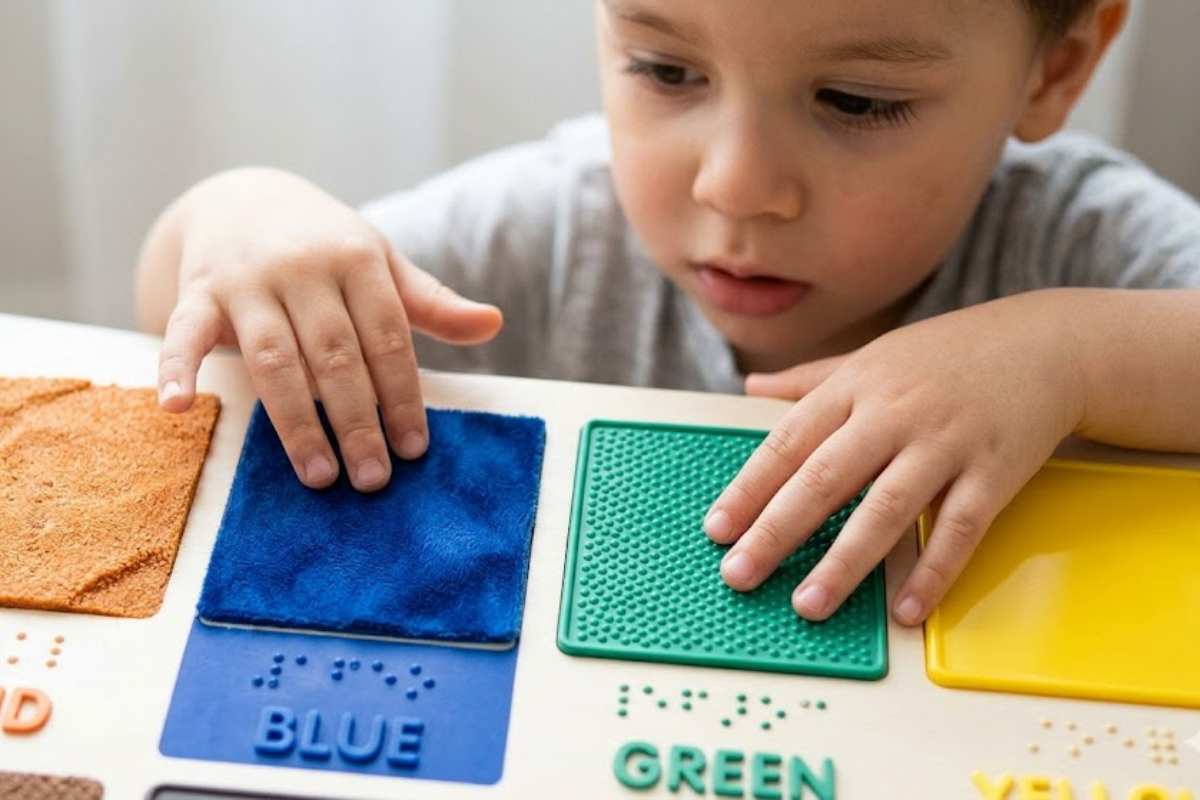
- Tactile Colour Charts:Braille-labelled swatches of fabric, sandpaper, and plastic (available from National Association for the Blind, Mumbai).
- Concept Development:Ensuring the child knows “red” before teaching “red light means stop” in mobility training.
- Assistive Technology:Training to use devices like the “Colourino” (a small scanner that speaks colours aloud).
- Peer Learning:Blind children teach each other colour associations (e.g., “For me, black is the silence after a loud cracker”).
Best Schools and Institutes for Blind Children in India
| Institute | Location | Special Features for Colour Teaching |
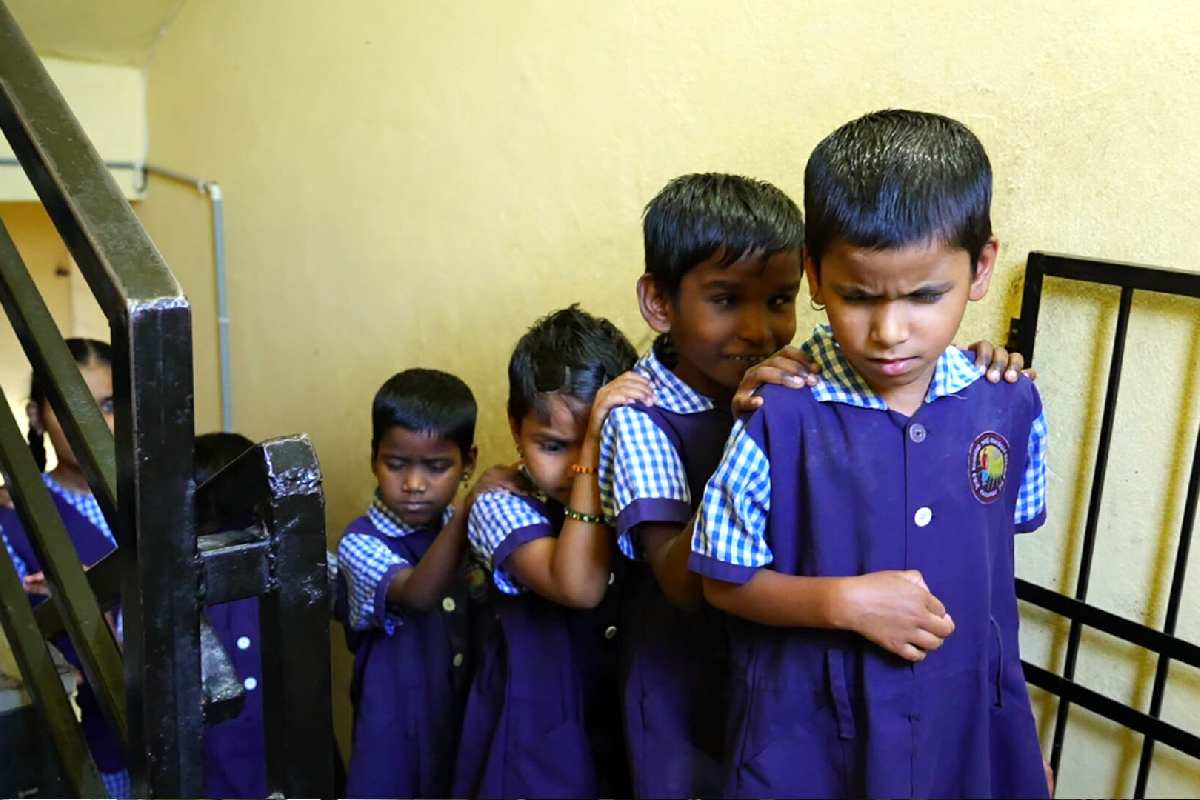
| National Association for the Blind (NAB) | Mumbai (HQ); branches in Delhi, Kolkata, Chennai | Has “Sensory Kits” for colours; teacher training programs; low-cost tactile colour charts. |
| St. Mary’s School for the Blind | New Delhi | Uses “Colour of the Day” with edible objects (red: apple pieces); integrates music with colours. |
| Ramana Maharshi Academy for the Blind | Bengaluru | Focuses on vocational colour training (sorting beads, fabric for weaving). |
| Andh Kanya Prakash Gruha | Ahmedabad | Residential; uses Indian festival foods to teach colours (e.g., theragam – orange sweets). |
| Helen Keller Institute for Deaf & Deafblind | Mumbai | Specialises in tactile colour discrimination using thermal paper (heat changes texture by colour). |
| Jyothi Seva Home for the Blind | Bengaluru | Uses “Colour Walk” paths – different floor textures for different colour zones. |
| L.V. Prasad Eye Institute (Rehabilitation Wing) | Hyderabad | Offers home-based training for parents to create colour kits using local spices and cloth. |
Assistive Tools Available in India to Teach Colours
| Tool | Type | How It Helps | Approx. Price (INR) | Where to Find |
| Colourino | Electronic colour detector | Speaks colour name aloud (English/Hindi); beeps for light/dark. | 8,000 – 10,000 | NAB Mumbai, Amazon India |
| Tactile Colour Cards | Cardboard + textures | Red = sandpaper, Blue = velvet, Yellow = silk. Pre-made with Braille. | 500 – 1,000 | NAB, Raised Lines Foundation (Delhi) |
| Sunu Band | Smart wristband | Vibrates differently for light colours (fast vibration) vs dark (slow); senses sunlight. | 25,000 | Online (special order) |
| Be My Eyes App | Free smartphone app | Volunteer describes colour of object via live video call. | Free | Google Play / iOS |
| Seeing AI (Microsoft) | Free app | “Colour Recognizer” channel – tap screen, hears colour. | Free | iOS only |
| Colour Detector Pen (PenFriend) | Audio labelling pen | Record “This is red” sticker on red object; child scans pen to hear. | 12,000 (one-time) | NAB, VisionAid (Bangalore) |
| Homemade Colour Box | DIY (matchbox + textures) | Child matches red rough (sand) to red rough (brick piece) without seeing. | ~100 | Make at home |
Common Challenges Indian Parents Face While Teaching Colours
- Abstractness:The child asks, “If I can’t see it, why does it matter what colour the sky is?” Parents struggle to give functional answers.
- Inconsistent associations:One relative says red is hot (chilli), another says red is cold (raspberry ice cream). Confusion.
- Lack of ready tactile materials:Most Indian toys are visual (coloured plastic with no texture difference). Expensive to buy imported kits.
- Social pressure:Grandparents insist the child must “learn colours” to appear normal, leading to rote memorisation without understanding.
- Overload of festivals:Holi becomes scary (powder in eyes, mouth) rather than a colour lesson.
- Language barriers:Many colour-teaching apps are English-only; regional words for colours (e.g., laal, peela) have no tactile anchor.
- Safety vs. exploration:Letting a child touch a red hot stove to learn “red = hot” is dangerous. Finding safe heat sources is hard.
Tips from Indian Experts on Raising a Visually Impaired Child
- Samir Dalwai (Developmental Paediatrician, Mumbai):“Don’t teach colours – teach properties. Say ‘smooth red’ vs ‘rough red’. The adjective gives the colour meaning.”
- Nivedita (Special Educator, NAB Delhi):“Use the ‘Two-Second Rule’ – after the child touches an object, say its colour twice. ‘Tomato. Red. Red.’ Repetition is memory.”
- K.K. Ramamurthy (Blind parent, Chennai):“Let them make mistakes. If they call a green chilli ‘red’, ask ‘Is it hot like a red thing?’ Let them taste it. Then correct.”
- Praveen (LVPEI Hyderabad):“Involve siblings. Sighted siblings can describe colours during play – ‘Your toy car is blue like the cold water.’ It feels normal, not like a lesson.”
- Anuradha (Teacher, Jyothi Seva, Bangalore):“Celebrate small wins. If the child correctly pairs warm to ‘orange’ once a week, that’s progress. Don’t expect daily consistency.”
How to Build Confidence and Imagination Without Visual Experience
Confidence in a blind child comes from successful prediction. When the child learns that a smooth, cold, heavy, round object in the fridge is always a green apple (tart taste) vs. a smooth, cold, heavy, round object in the fruit bowl is an orange (sweet, bumpy), they learn that the world has predictable rules. Colour becomes one of those rules. By consistently linking colours to non-visual anchors (e.g., “Every time you hear the pressure cooker whistle, the lentils inside are yellow and hot”), the child builds confidence to ask, “What colour is this?” instead of feeling lost. This transforms helplessness into curiosity.
Imagination for a blind child is not about picturing a red sunset; it is about combining sensory memories. To imagine “a red velvet dress in a blue room,” the child recalls the feel of velvet (smooth one way, rough another), the smell of a cold room (like blue – a fridge), and the sound of rustling cloth. The parent’s job is to provide rich, varied, and consistent sensory experiences. Describe a hero’s red cape as “the sound of a flag in a strong wind, the warmth of a sun-heated brick, and the taste of spicy tomato soup all together.” That is imagination – not seeing, but feeling across senses.
Conclusion
Teaching colours to blind children in India is entirely possible, but it requires a shift from visual to sensory thinking. By anchoring colours in touch (rough red brick, smooth green leaf), taste (sour yellow lemon, sweet orange halwa), temperature (cold blue water, warm red tea), and emotions (festival excitement = orange), parents can build a functional colour vocabulary. The goal is not for the child to “see” colours, but to use colour as a practical tool for safety (red = hot, stop), organisation (sorting clothes by colour), and social participation (knowing that the Indian flag is saffron, white, green). With India’s rich sensory environment – from spice markets to textile shops to festivals – and growing assistive technology, blind children can learn colours as vividly as anyone, just through different doors of perception.
FAQs
- At what age can a blind child start learning colours?
From 18 months, using concrete objects (e.g., “This is a red ball”). Abstract colour concepts develop around 4-5 years. - What if my child mixes up colour names constantly?
Normal. Focus on one colour per week. Use only red objects for 7 days. After mastery, add a contrasting colour (red vs. blue). - Can blind children understand colour if they have never seen it?
Yes, as a social convention and functional property, not as a visual sensation. They learn that “red” means a certain set of tactile/thermal/taste rules. - Which is the cheapest assistive tool to start with?
A homemade colour box (₹100). Take 5 matchboxes, paste different textures inside (sandpaper=red, velvet=blue, silk=yellow). Child feels and matches. - How do I explain that two different objects (tomato and brick) are both “red”?
Make the child feel both. Say: “Tomato is red-soft-wet. Brick is red-hard-rough. Different feelings, same name – red. Red means warm and strong.”