


This article belongs to Other
Table of Contents
What Is EHR Dr Care?
EHR Dr Care is a comprehensive Electronic Health Records (EHR) and practice management software solution designed specifically for the Indian healthcare ecosystem. It serves as a digital platform that enables healthcare providers—from individual doctors and small clinics to multi-specialty hospitals—to digitize, store, and manage patient health records efficiently. The system integrates clinical workflows, administrative tasks, billing, and patient communication into a unified digital interface, replacing traditional paper-based medical records .
Unlike basic hospital management systems, EHR Dr Care focuses on creating a longitudinal health record for each patient, meaning that every consultation, prescription, lab report, diagnosis, and treatment plan is captured and linked to a single patient profile. This creates a complete medical history that can be accessed across different departments and over time. The software typically includes modules for outpatient and inpatient management, electronic prescribing (e-prescriptions), laboratory information management, pharmacy billing, appointment scheduling, and telemedicine integration .
Overview
| Aspect | Details |
| Product Name | EHR Dr Care |
| Category | Electronic Health Records (EHR) / Hospital Management Information System (HMIS) |
| Target Users | Doctors, clinics, nursing homes, multi-specialty hospitals, diagnostic centers |
| Deployment Model | Cloud-based (SaaS) with optional on-premise installation |
| Key Differentiator | India-specific workflows, ABDM compliance, affordable pricing for small practices |
| Regulatory Compliance | ABDM (Ayushman Bharat Digital Mission), HIPAA standards, Data Protection Bill readiness |
| Integration Capabilities | Telemedicine platforms, lab equipment, pharmacy systems, payment gateways |
| Language Support | Multiple Indian languages (English, Hindi, regional languages) |
| Accessibility | Web-based, Android/iOS mobile apps, offline mode support |
| Data Ownership | Complete data ownership with healthcare provider; exportable in standard formats |
| Support Model | 24/7 technical support, on-site training available, online knowledge base |
| Typical Pricing | Subscription-based (₹1,500-₹5,000/month per provider) or one-time license |
Role of EHR Dr Care in India’s Digital Healthcare System
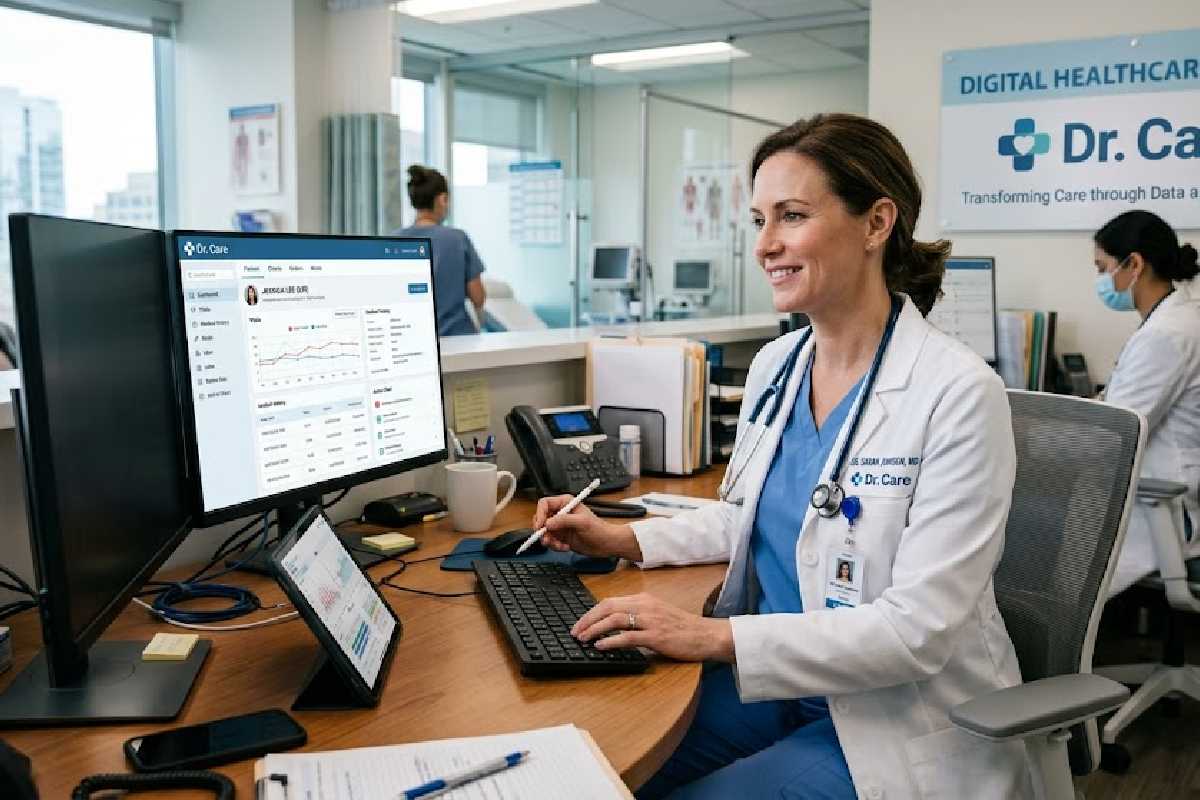
EHR Dr Care plays a pivotal role in advancing India’s digital healthcare transformation. The software aligns with and supports several key government initiatives aimed at creating a unified, interoperable digital health ecosystem across the country .
| Aspect | Detail |
| Alignment with ABDM | Enables ABHA ID creation, health record linking, and consent-based data sharing |
| Support for e-Sanjeevani | Integrates with India’s national telemedicine platform for remote consultations |
| Contribution to U-WIN | Facilitates vaccination record digitization under Universal Immunization Programme |
| Integration with e-Hospital | Compatible with NIC’s hospital management system for government facilities |
| Promotion of Paperless Healthcare | Reduces physical storage needs and enables seamless data transfer between providers |
| Support for Ayushman Arogya Mandirs | Enables digitization of primary health centers for early disease diagnosis |
| Facilitation of Health Data Management Policy | Ensures compliance with data privacy, security, and consent management standards |
Key Features of EHR Dr Care Software
EHR Dr Care offers a comprehensive suite of features designed to streamline clinical, administrative, and financial operations within healthcare facilities. The system is built with Indian healthcare workflows in mind, addressing the specific needs of both small clinics and large hospitals .
| Feature Category | Specific Features | Description |
| Patient Management | ABHA ID Integration | Create and link Ayushman Bharat Health Accounts for seamless patient identification |
| Patient Registration | Capture demographic, clinical, and insurance information in structured formats | |
| Unified Patient View | Access complete medical history, past visits, prescriptions, and reports from single dashboard | |
| Queue Management | Digital token system for OPD waiting areas with real-time status updates | |
| Clinical Documentation | E-Prescriptions | Generate digital prescriptions with drug databases, dosage calculators, and allergy alerts |
| SOAP Notes | Structured documentation for Subjective, Objective, Assessment, and Plan notes | |
| Problem Lists | Track active and resolved medical conditions with timeline view | |
| Procedure Documentation | Record surgical and interventional procedures with templated forms | |
| Laboratory & Diagnostics | Lab Order Management | Order tests electronically with customizable requisition forms |
| Result Integration | Auto-import results from connected lab equipment or manual entry with reference ranges | |
| Trend Analysis | Visualize lab values over time with graphical representations | |
| Critical Value Alerts | Automatic notifications for abnormal or critical lab results | |
| Pharmacy & Inventory | E-Prescription to Pharmacy | Direct transmission of prescriptions to in-house or partner pharmacies |
| Drug Interaction Checking | Real-time alerts for potential drug-drug and drug-allergy interactions | |
| Inventory Management | Track stock levels, expiry dates, and reorder points for medications and supplies | |
| Billing Integration | Automatic charge capture based on prescribed medications and procedures | |
| Appointment & Scheduling | Online Booking | Patient self-scheduling via web portal or mobile app with real-time availability |
| Resource Allocation | Manage doctor schedules, room assignments, and equipment availability | |
| Automated Reminders | SMS and email notifications for upcoming appointments and follow-ups | |
| Waitlist Management | Automated waitlist and notification when slots become available | |
| Inpatient Management | Bed Management | Real-time view of bed occupancy, availability, and assignment by ward and room type |
| Admission/Discharge/Transfer | Digital workflows for patient movement within facility | |
| Discharge Summary | Generate comprehensive discharge summaries with medications, follow-ups, and instructions | |
| Diet Planning | Integration with dietary services for customized meal plans | |
| Operation Theatre Management | OT Scheduling | Manage surgery bookings, equipment requirements, and staff assignments |
| Pre-op Checklists | Digital verification of pre-operative requirements | |
| Intra-operative Records | Document surgical findings, implants used, and procedure details | |
| Post-op Tracking | Monitor recovery milestones and follow-up schedules | |
| Billing & Finance | Insurance Integration | Process cashless claims with TPA connectivity and pre-authorization management |
| Package Management | Create and manage treatment packages (e.g., maternity, cataract packages) | |
| Payment Gateway | Online payment collection via UPI, cards, and net banking | |
| Financial Reporting | Generate revenue reports, collection summaries, and outstanding payment tracking | |
| Telemedicine Integration | Video Consultations | In-platform video calling with recording consent and documentation |
| Remote Prescribing | E-prescriptions for teleconsultations with digital signatures | |
| Patient Portal | Allow patients to view records, request appointments, and message providers | |
| Home Health Monitoring | Integration with wearable devices for remote vitals monitoring | |
| Reporting & Analytics | Clinical Dashboards | Visualize key metrics like patient flow, diagnosis patterns, and treatment outcomes |
| Operational Reports | Generate OPD statistics, admission rates, bed occupancy, and referral patterns | |
| Financial Analytics | Track revenue cycles, payer mix, and collection efficiency | |
| Regulatory Reporting | Automated generation of reports for government health programs and audits | |
| Security & Compliance | Role-Based Access Control | Granular permissions based on user role (doctor, nurse, admin, billing) |
| Audit Trails | Complete log of who accessed or modified patient records with timestamps | |
| Consent Management | Patient-controlled consent for data sharing with third parties | |
| Data Encryption | End-to-end encryption for data at rest and in transit |
How EHR Dr Care Improves Patient Record Management
EHR Dr Care transforms patient record management from a fragmented, paper-based process to an integrated, digital workflow that enhances accuracy, accessibility, and efficiency. The system addresses the fundamental limitations of traditional medical records while introducing capabilities that were previously impossible with paper systems .
Elimination of Physical Record Fragmentation:
In paper-based systems, a patient’s records are often scattered across multiple departments, files, and locations. A lab report might be in one folder, prescription in another, and discharge summary in a third file. EHR Dr Care consolidates all patient information into a single, unified digital record that can be accessed instantly from any authorized workstation. This eliminates the time wasted searching for missing files and prevents the frustration of incomplete records during consultations .
Real-Time Updates and Accessibility:
When a doctor updates a patient’s record, adds a prescription, or orders a test, the information is available immediately to all authorized healthcare providers across the facility. A nurse on the inpatient ward can see the latest doctor’s orders seconds after they are entered. A pharmacist can verify a prescription before the patient reaches the pharmacy counter. This real-time synchronization reduces delays, prevents miscommunication, and accelerates care delivery .
Longitudinal Patient History:
EHR Dr Care maintains a lifetime health record for each patient, capturing every encounter across years or decades. This longitudinal view allows clinicians to identify patterns, track disease progression, and make informed decisions based on complete historical data. For chronic disease management, this is particularly valuable—a diabetologist can see blood sugar trends over five years, identify seasonal variations, and adjust treatment protocols accordingly .
Structured Data for Better Decision Making:
Unlike handwritten notes that vary in quality and completeness, EHR Dr Care uses structured templates and standardized coding (ICD-11 for diagnoses, LOINC for lab tests). This structured data enables:
- Clinical decision support (alerts for drug interactions, allergy warnings)
- Population health analytics (identifying disease clusters, treatment effectiveness)
- Quality measurement (tracking compliance with clinical guidelines)
- Research and audit capabilities (aggregated data analysis)
Reduction of Medical Errors:
Studies have shown that EHR systems can reduce medication prescribing errors by up to 48% and improve adherence to care standards significantly . EHR Dr Care incorporates multiple safety features:
- Legible, standardized prescriptions eliminate handwriting misinterpretation
- Drug interaction checking prevents harmful combinations
- Allergy alerts warn before prescribing contraindicated medications
Benefits of Using EHR Dr Care for Clinics and Hospitals
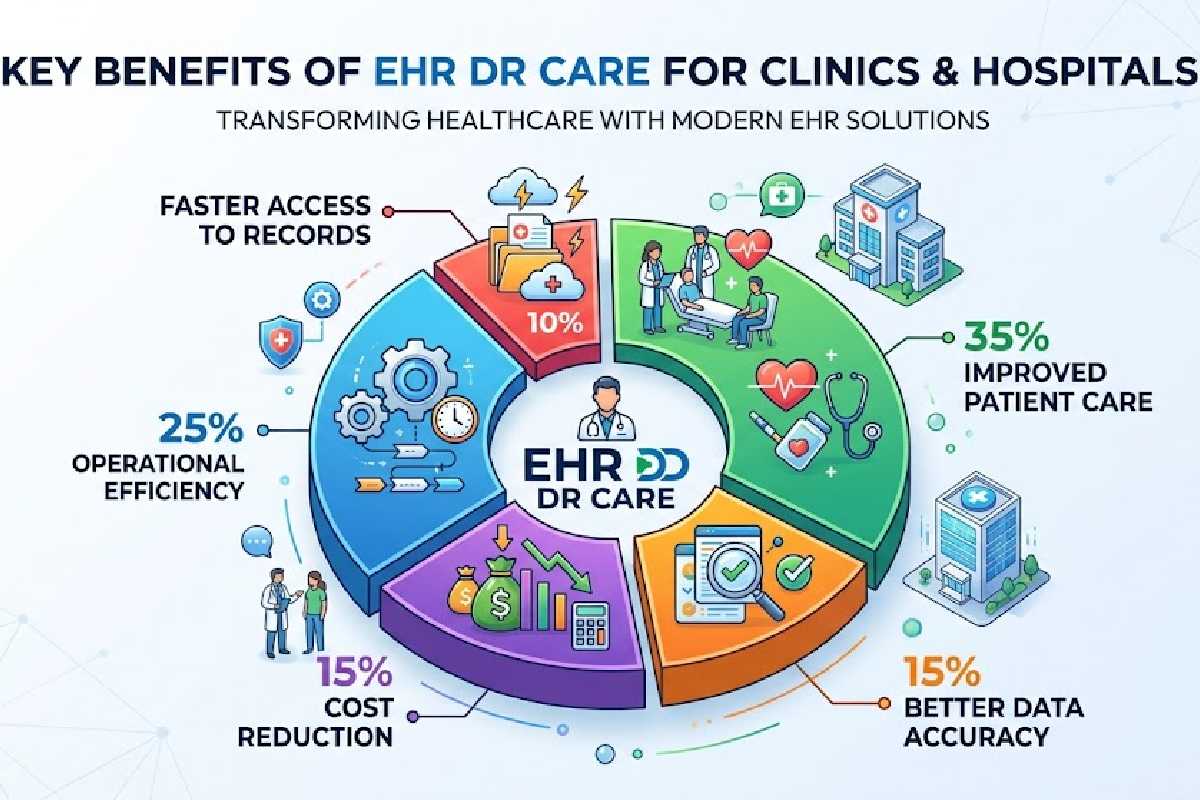
The implementation of EHR Dr Care delivers measurable benefits across clinical, operational, and financial dimensions. Healthcare providers who have adopted electronic health record systems report significant improvements in care quality, staff productivity, and revenue cycle management .
Clinical Benefits:
- Improved Diagnostic Accuracy: Complete patient history, including past diagnoses, medications, allergies, and test results, is available at the point of care, reducing diagnostic errors.
- Enhanced Care Coordination: Multiple providers can collaborate on a patient’s care with shared access to the same information, reducing duplication and gaps in care.
- Evidence-Based Practice: Clinical decision support tools provide guideline-based recommendations, drug interaction alerts, and preventive care reminders.
- Better Chronic Disease Management: Tracking of key metrics (BP, blood sugar, lipid profiles) with trend analysis enables proactive adjustments to treatment plans.
- Reduced Adverse Drug Events: Allergy checking, drug interaction alerts, and appropriate dosing guidance prevent medication-related harm.
Operational Benefits:
- Increased Staff Productivity: Eliminates time spent searching for paper charts, manually entering data, and tracking down missing information. Studies show 10-20% time savings for clinical staff .
- Streamlined Workflows: Automated appointment scheduling, prescription transmission, and lab order processing reduce administrative bottlenecks.
- Reduced Paper and Storage Costs: Eliminates costs of paper, printing, physical file storage, and record transport between departments.
- Faster Patient Throughput: Reduced waiting times as registration, consultation, billing, and pharmacy processes become more efficient.
- Better Resource Utilization: Real-time visibility into bed occupancy, equipment availability, and staff schedules enables optimal resource allocation.
Financial Benefits:
- Improved Revenue Capture: Automated charge capture ensures all billable services are recorded and claimed, reducing revenue leakage.
- Faster Claim Processing: Integrated insurance billing with electronic claim submission reduces rejection rates and accelerates reimbursement.
- Reduced Denial Rates: Accurate documentation and coding improve first-pass claim acceptance rates.
- Lower Administrative Costs: Reduced manual data entry, fewer billing errors, and automated follow-ups decrease administrative overhead.
- Incentive Eligibility: Compliance with ABDM and other digital health initiatives makes providers eligible for government incentives .
Patient Experience Benefits:
- Reduced Wait Times: Efficient workflows translate to shorter waiting periods for consultations, tests, and medications.
- No Repeated Information: Patients don’t have to repeatedly provide their medical history to different providers.
- Easy Access to Records: Patient portal provides 24/7 access to reports, prescriptions, and visit summaries.
- Better Communication: Automated appointment reminders, test result notifications, and follow-up alerts keep patients informed.
- Coordinated Care: When referred to specialists, patients don’t need to carry physical files—records are shared electronically with consent.
EHR Dr Care vs Traditional Paper-Based Medical Records
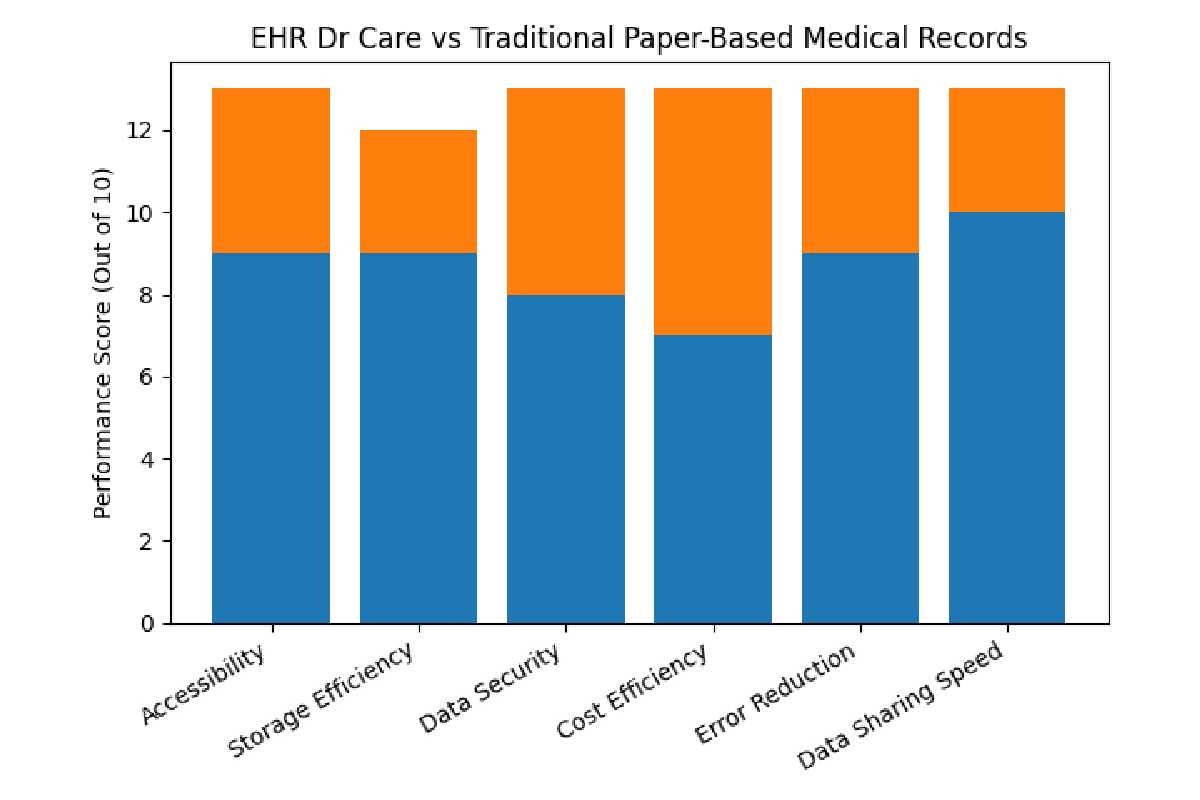
The transition from paper-based records to EHR Dr Care represents a fundamental shift in how healthcare is delivered and managed. While paper records have served healthcare for centuries, they are increasingly inadequate for modern, data-driven, coordinated care. The following comparison illustrates the key differences .
| Aspect | Paper-Based Medical Records | EHR Dr Care |
| Data Accessibility | Single physical location; only one person can access at a time | Multiple concurrent users; accessible from any authorized device |
| Remote Access | Impossible without physical transport of files | Secure cloud access from anywhere with internet |
| Data Legibility | Variable; depends on handwriting quality; common source of errors | Always legible; standardized fonts and formats |
| Data Completeness | Frequently missing pages, illegible sections, lost documents | Structured fields require completion; mandatory data entry |
| Record Retrieval Time | 5-15 minutes to locate, retrieve, and return files | 2-5 seconds with search functionality |
| Storage Requirements | Physical space; filing cabinets; offsite storage for old records | Cloud storage; no physical space required |
| Data Backup | Manual photocopying; vulnerable to fire, flood, theft | Automated encrypted backups; multiple geographic redundancy |
| Search Capability | Manual browsing through files | Instant search by name, date, diagnosis, medication, lab value |
| Data Sharing | Photocopying and courier; days to weeks | Electronic sharing with consent; seconds to minutes |
| Regulatory Compliance | Difficult to track access; limited audit capabilities | Comprehensive audit trails; detailed access logs |
| Clinical Decision Support | None; relies on clinician memory and reference books | Drug interaction alerts, allergy warnings, guideline reminders |
| Population Health Management | Manual chart reviews; time-prohibitive | Automated analytics; identify cohorts by diagnosis, lab values |
| Billing Integration | Manual charge entry; frequent missed charges | Automatic charge capture from documentation |
| Patient Engagement | Patients rarely see records; no remote access | Patient portal with 24/7 access to personal health data |
| Disaster Recovery | Vulnerable to complete loss | Rapid restoration from cloud backups |
| Environmental Impact | Significant paper consumption | Reduced paper usage; digital workflows |
Data Security and Privacy in EHR Dr Care Systems
Data security and patient privacy are paramount concerns in electronic health records, and EHR Dr Care incorporates multiple layers of protection to safeguard sensitive health information. The system is designed to comply with Indian regulations, including the Health Data Management Policy under ABDM and the forthcoming Digital Personal Data Protection Act, as well as international standards like HIPAA where applicable .
Access Control and Authentication: EHR Dr Care implements role-based access control (RBAC), ensuring that users can only access the information necessary for their role. A front-desk receptionist might only see demographic and scheduling information, while a doctor has full clinical access. The system supports:
- Multi-factor authentication for added security
- Single sign-on integration with existing identity management systems
- Session timeouts to prevent unauthorized access from unattended workstations
- Geolocation restrictions for remote access
- Data Encryption: All patient data is protected using strong encryption standards:
- Data at Rest: Encrypted using AES-256 on storage devices and cloud servers
- Data in Transit: Encrypted using TLS 1.3 during transmission between clients and servers
- Backup Encryption: Backups are encrypted before being stored in secondary locations
- Audit Trails: The system maintains comprehensive audit logs that track every interaction with patient data. For each access or modification, the log records:
- Who accessed the record (user ID)
- When the access occurred (timestamp)
- What action was performed (view, edit, delete, print, share)
- What specific data was accessed (which fields or documents)
- From where the access originated (IP address, device identifier)
These audit trails are tamper-evident and can be reviewed by security officers, compliance teams, or during legal discovery.
Use of EHR Dr Care in Small Clinics vs Large Hospitals
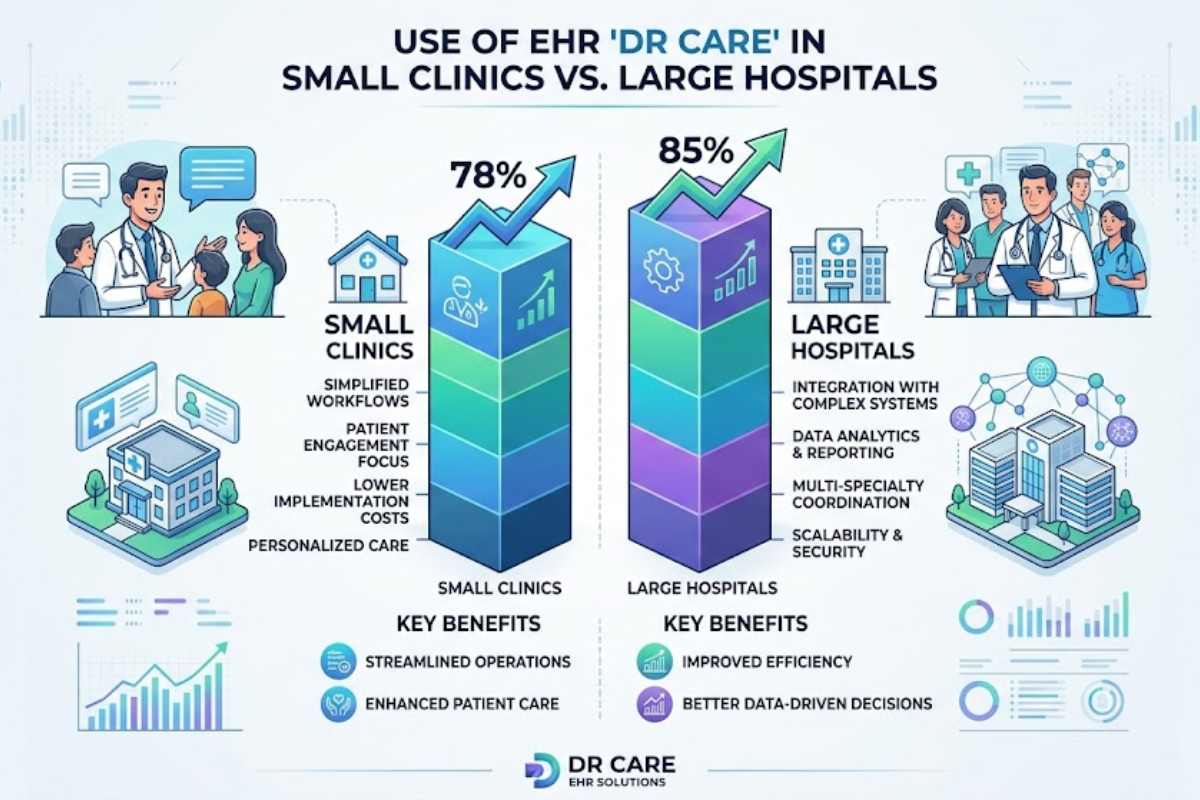
| Aspect | Small Clinics | Large Hospitals |
| Scale of Usage | Used for limited patient records and basic operations | Handles thousands of patient records and complex workflows |
| Cost & Investment | Low-cost setup, budget-friendly for small practices | High investment for full-scale integration and customization |
| Implementation Time | Quick and easy setup | Longer implementation due to system complexity |
| Features Used | Basic features like patient records, prescriptions, billing | Advanced features like multi-department management, analytics, lab integration |
| User Base | Few users (doctor + assistant/receptionist) | Large number of users (doctors, nurses, admin, specialists) |
| Customization | Limited customization required | Highly customized to suit hospital departments and processes |
| Data Management | Manages smaller datasets | Handles massive and complex datasets across departments |
| Integration | Minimal integration (pharmacy, basic lab) | Extensive integration (labs, radiology, insurance, pharmacy systems) |
| Training Requirement | Minimal training needed | Requires structured and ongoing staff training |
| Maintenance | Easy to maintain with basic IT support | Needs dedicated IT teams for maintenance and upgrades |
| Security Needs | Basic data security measures | Advanced security protocols and compliance requirements |
| Patient Handling | Suitable for low to moderate patient flow | Designed for high patient volume and emergency cases |
| Decision Support | Limited decision-making tools | Advanced clinical decision support systems (CDSS) |
| Scalability | Limited scalability | Highly scalable for expansion and multiple branches |
| Workflow Complexity | Simple workflows | Complex, multi-layered workflows across departments |
Common Challenges in Implementing EHR Dr Care in India
While EHR Dr Care offers significant benefits, implementation in the Indian healthcare context presents unique challenges. Understanding these challenges is essential for successful adoption. Research conducted at Indian healthcare facilities has identified several key barriers .
| Challenge Category | Specific Barrier | Prevalence in Indian Context |
| Financial | High upfront costs for software and hardware | Major barrier for 80% of small clinics |
| Financial | Ongoing subscription and maintenance costs | Moderate barrier |
| Infrastructure | Unreliable internet connectivity | Significant barrier in rural areas |
| Infrastructure | Inconsistent electricity supply | Moderate barrier in tier-2/3 cities |
| Infrastructure | Insufficient computers/devices | Major barrier for small facilities |
| Technical | Software complexity and usability issues | Moderate barrier |
| Technical | Lack of technical support | Significant barrier for remote locations |
| Human | Low digital literacy among staff | Major barrier for older practitioners |
| Human | Resistance to change from paper workflows | Significant barrier |
| Human | Inadequate training resources | Moderate barrier |
| Organizational | Lack of dedicated IT personnel | Major barrier for small facilities |
| Organizational | Poor change management during implementation | Significant barrier |
| Regulatory | Data privacy and security concerns | Moderate barrier |
| Regulatory | Unclear legal status of e-records | Low barrier |
Strategies to Overcome Challenges:
- Phased Implementation: Start with basic modules (registration, prescriptions) before adding advanced features
- Cloud-Based Deployment: Eliminates need for on-premise servers; reduces upfront costs
- Offline Mode: Allows continued operation during internet outages with synchronization when connectivity returns
- Comprehensive Training: Initial training plus ongoing support and refresher sessions
- Champion Identification: Designate tech-savvy staff members to help colleagues and promote adoption
- Government Incentives: Leverage DHIS and other schemes to offset implementation costs
Cost and Pricing of EHR Dr Care Solutions
| Cost Component | Small Clinics (Basic Use) | Medium Clinics / Multi-Doctor Setup | Large Hospitals / Enterprise |
| Pricing Model | Mostly subscription (monthly/yearly) | Subscription + optional add-ons | Enterprise license / hybrid model |
| Monthly Cost | ₹500 – ₹2,000 | ₹2,000 – ₹10,000 | ₹50,000+ (or custom pricing) |
| Annual Cost | ₹6,000 – ₹20,000 | ₹20,000 – ₹1,50,000 | ₹1 lakh – ₹10+ lakh/year |
| One-Time License (if any) | ₹10,000 – ₹50,000 | ₹50,000 – ₹2,00,000 | ₹10 lakh – ₹50 lakh+ |
| Implementation Cost | Minimal or free | ₹10,000 – ₹1,00,000 | ₹1 lakh – ₹10 lakh |
| Customization Cost | Rare / basic | ₹20,000 – ₹2 lakh | ₹2 lakh – ₹20 lakh |
| Training Cost | ₹5,000 – ₹15,000 | ₹10,000 – ₹50,000 | ₹50,000 – ₹5 lakh |
| Maintenance / AMC | Included in SaaS | 10–20% annually (if licensed) | 15–25% annually |
| Per User Cost | ₹200 – ₹1,000/month | ₹500 – ₹2,000/month | Custom pricing per department/user |
| Hardware / Infrastructure | Not required (cloud-based) | ₹20,000 – ₹1 lakh | ₹1 lakh – ₹10 lakh+ |
| Integration Cost (Labs, Pharmacy, etc.) | Minimal / optional | ₹10,000 – ₹1 lakh | ₹1 lakh – ₹10 lakh |
| SMS / Notification Charges | ₹0.10 – ₹0.50 per SMS | Same | Same but higher volume |
| Upgrade Charges | Usually free | Sometimes paid upgrades | Paid major upgrades (10–30%) |
| Hidden Costs | Add-ons, extra users | Integration, support, scaling | Data migration, compliance, IT team |
| Total Estimated Cost (1st Year) | ₹10,000 – ₹50,000 | ₹50,000 – ₹3 lakh | ₹5 lakh – ₹50 lakh+ |
Where to Access or Implement EHR Dr Care in India
| Access / Implementation Method | Platform / Example | How It Is Accessed | Suitable For | Key Features / Benefits |
|---|---|---|---|---|
| EHR Software Providers | Drlogy, Healthray, Practo Ray | Register on provider website, take demo, subscribe | Clinics, hospitals, doctors | Cloud access, patient records, billing, prescriptions |
| Cloud-Based (SaaS) Platforms | Web portals & mobile apps | Login via browser/app with subscription | Small clinics, individual doctors | Access anytime, no installation, low cost, remote usage |
| On-Premise Systems | Installed hospital software systems | Installed on hospital servers with IT support | Large hospitals | Full data control, high security, department integration |
| Hospital Management Systems (HIMS) | Integrated systems like Healthray HMIS | Combined with hospital software | Multi-specialty hospitals | Manages OPD, IPD, lab, pharmacy in one system |
| Government Digital Health Platforms | Ayushman Bharat Digital Mission | Register using ABHA ID | All healthcare providers | Standardized digital records, nationwide access |
| Diagnostic & Lab Integration | Labs connected to EHR systems | Integrated via software APIs | Clinics & hospitals | Real-time lab reports, reduced manual entry |
| Mobile & Telemedicine Apps | Mobile EHR apps | Download app, login with credentials | Doctors & tele-consultants | Remote consultation, digital prescriptions |
| Custom Healthcare IT Solutions | Private IT vendors | Custom development & deployment | Large hospital chains | Tailored workflows, scalability, advanced analytics |
| Multi-Clinic Chains / Networks | Chain hospitals using centralized EHR | Central server/cloud access | Hospital groups | Shared patient data across branches |
| Direct Vendor Implementation Process | Any EHR provider | Demo → Subscription → Setup → Training | All healthcare setups | Quick onboarding, staff training, go-live support |
Conclusion
EHR Dr Care represents a significant advancement in India’s journey toward a digitized, integrated healthcare system. By providing a comprehensive electronic health records solution designed specifically for Indian workflows, the software addresses the unique challenges of the country’s diverse healthcare landscape—from small single-doctor clinics to large multi-specialty hospitals.
The benefits of adopting EHR Dr Care are substantial and well-documented: improved clinical outcomes through better access to complete patient information, reduced medical errors through decision support and safety checks, enhanced operational efficiency through streamlined workflows, and better financial performance through improved revenue capture and reduced administrative costs.
However, successful implementation requires careful planning, adequate training, and a commitment to change management. Financial constraints, infrastructure limitations, and staff resistance remain significant barriers, particularly for smaller facilities and those in rural areas. Government initiatives like ABDM and DHIS are helping to address these challenges through incentives, standardization, and infrastructure development.
Frequently Asked Questions (FAQs)
Q1: Is EHR Dr Care compliant with the Ayushman Bharat Digital Mission (ABDM)?
Yes, EHR Dr Care is fully compliant with ABDM standards. The software enables creation of Ayushman Bharat Health Accounts (ABHA), linking of health records to these unique identifiers, and secure, consent-based data sharing across the ABDM network. This compliance also makes users eligible for the Digital Health Incentive Scheme (DHIS) .
Q2: Can EHR Dr Care work without an internet connection?
Yes, EHR Dr Care includes an offline mode that allows continued operation during internet outages. Data entered while offline is stored locally and automatically synchronized with the cloud servers when connectivity is restored. This feature is particularly valuable for facilities in areas with unreliable internet access .
Q3: How much does EHR Dr Care cost for a small clinic with 2 doctors?
For a small clinic with 2 doctors, the typical cost is ₹3,000-6,000 per month on a per-provider subscription model. This includes all core features (patient registration, e-prescriptions, appointment scheduling, basic billing) and standard technical support. One-time setup and training costs are approximately ₹5,000-10,000.
Q4: Is my patient data secure with EHR Dr Care?
Yes, EHR Dr Care implements multiple layers of security including role-based access control, encryption of data at rest (AES-256) and in transit (TLS 1.3), comprehensive audit trails, and patient-controlled consent management. All data is stored on secure Indian servers in compliance with local data protection regulations .
Q5: Can EHR Dr Care integrate with existing lab equipment and pharmacy systems?
Yes, EHR Dr Care supports integration with laboratory information systems (LIS) for auto-import of test results and with pharmacy systems for electronic prescription transmission. The software uses standard interfaces (HL7, FHIR) for interoperability with compatible third-party systems .