

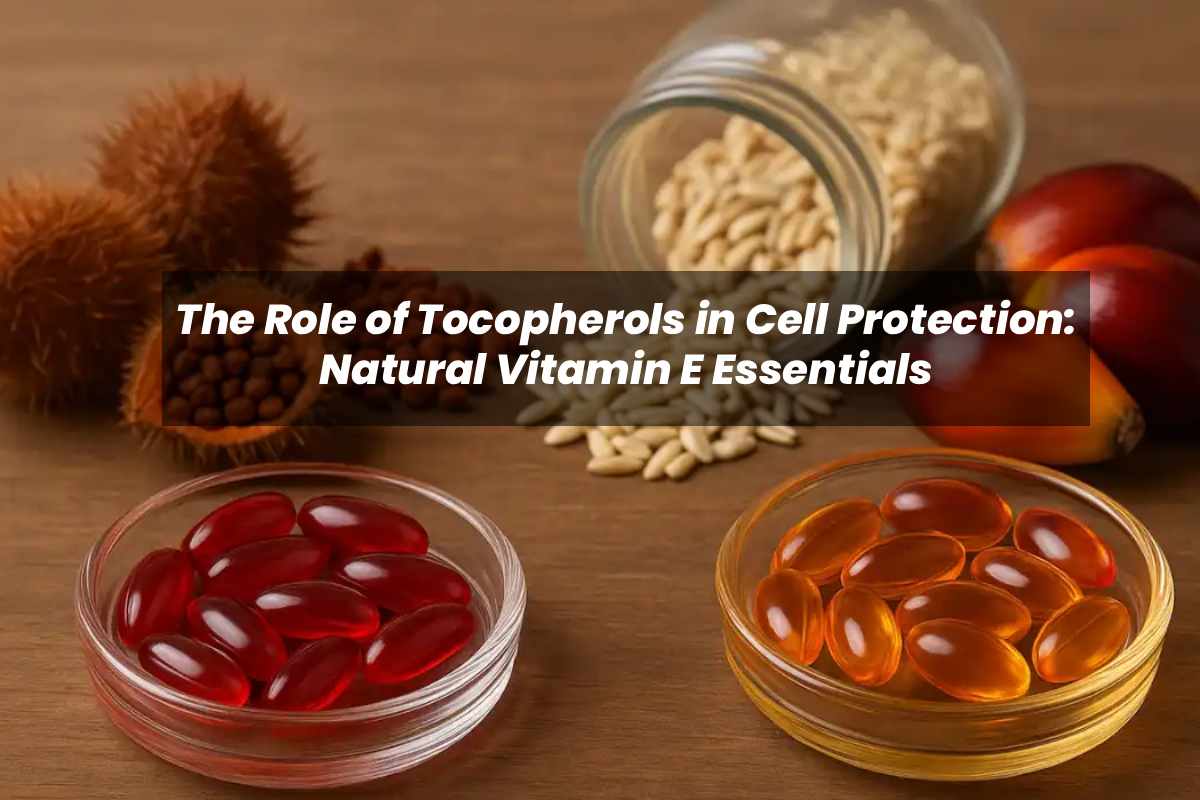
Inside the human cells’ microscopic world, a fight against oxidative damage that tries to destroy the cells’ structures and functions is going on. Leading this defensive fight are tocopherols, a group of one of the most biologically interesting compounds combined under the generic name vitamin E. These wonderful agents become the rescue team of the whole cell system, giving the most fragile parts of cells – the membranes – a heavy protection against the radical free attack which is the main cause of the whole chain from energy production to genetic stability being the most compromised. Knowing the mode of action of tocopherols and the importance of their natural forms is the main reason why this frequently-neglected nutrient should be put on the table of health and longevity talks at a much higher rank.
Table of Contents
Understanding the Tocopherol Family
Vitamin E is not one single substance, but rather a group of eight related compounds: four tocopherols (alpha, beta, gamma, and delta) and four tocotrienols, each differing from the other by a slight difference in their molecular structure. These differences may look insignificant from a chemical point of view, but they result in quite different biological activities in the human body. To a large extent, alpha-tocopherol has been the center of attention in most scientific studies, and it is the form that human tissues are most capable of retaining, thus, many supplement manufacturers choose to concentrate only on this one variant.
On the other hand, the sole focus on this one variant disregards the distinctive features of the other tocopherol forms. Gamma-tocopherol, the major source of which in the American diet is the consumption of pecans, walnuts, and sesame seeds, is very effective at neutralizing nitrogen-based free radicals to which alpha-tocopherol is not capable. Laboratory tests show that delta-tocopherol has the strongest antioxidant effect, while beta-tocopherol, by contrast, is a kind of median in the tocopherol scale. Nature offers these substances at different ratios in different foods, implying that the full family is not only mutually supportive but also dependent on one another.
The interaction of these various forms results in a quite comprehensive protective system that is stronger than any single tocopherol on its own. Cells in distress as a result of oxidative attack from various sources like pollution, metabolic byproducts, inflammatory processes, or radiation exposure, can have a wider defensive capacity if they can use the full range of tocopherols. This fact reaffirms a nutritional science axiom: isolated nutrients are less effective than the nutrient combinations that exist naturally.
The Mechanics of Cellular Protection
Cell membranes are notably sensitive targets of oxidative damage as they consist of fatty acids that are very prone to a destructive process known as lipid peroxidation. In case of free radicals assaulting these membrane lipids, they initiate chain reactions that can spread throughout the whole membrane structures, thus, the cell loses its capability to help with the exchange of substances with the outside, maintain normal internal conditions and communicate with neighboring cells. Over time, the damage that is left without any control, piles up and causes cellular dysfunction as well as accelerated aging.
Tocopherols are able to stop this harmful cascade through their special chemical properties. Their molecular configuration gives them the possibility to provide electrons to the unstable free radicals and thus, to make them stable and neutralize them before they attack membrane lipids. During this process, tocopherols become radicals themselves, however, they are quite stable ones and can be regenerated by other antioxidants such as vitamin C, thus forming an efficient recycling system that ensures high antioxidant capacity all the time. This regeneration network is the reason why vitamin E is most effective when working together with other protective nutrients rather than separately.
It is just as significant for the tocopherols to be in the right place for the execution of their protective effect as for them to have the right mechanism. These fat-soluble compounds, with the help of which the cell membranes remain intact, are actually the ones that the membranes are made up of – tocopherols locate themselves directly in the very membranes of cells and hence, they find the place where lipid peroxidation starts. Here, in this very moment, to the parts of the membrane where the free radicals have the potential to begin chain reactions, the tocopherols come and thus, they provide a first line of defense that is the closest one and also the most effective one because water-soluble antioxidants being in the cellular fluid cannot be there. Fat-soluble antioxidants as well as water-soluble ones are in a kind of relationship that allows for protective areas which are overlapping and are at work in cellular milieus.
Natural Versus Synthetic: Why Source Matters
The vitamin E supplement market essentially splits into two fundamentally different products: biologically active natural tocopherols obtained from plant sources, and synthetic ones made by chemical processes. Although these may look the same on supplement labels, their physiological activities vary to a large extent.
Natural vitamin E, indicated as d- alpha-tocopherol and quite often also comprising the mixed tocopherols, is a product that contains only the molecular form that the human body recognizes and utilizes most effectively. Synthetic vitamin E, referred to as dl-alpha-tocopherol, is a mixture of eight different molecular isomers, out of which only one is identical to the natural one.
Such a difference in the structure is significant since human protein carriers have higher affinity and transport the natural configuration thus natural vitamin E results in higher tissue concentrations from the same doses. In fact, studies very often pinpoint that natural forms have about double the biological activity as synthetic ones, thus they are considerably more cost-effective even if they are usually priced higher. Even more importantly, the body has to metabolize and excrete seven isomers which it does not recognize in synthetic vitamin E, hence it is possible that it is creating an unnecessary metabolic load without giving the equivalent benefit.
The case for natural sources grows even stronger when considering mixed tocopherol formulations. Products containing natural vitamin E concentrate with the full spectrum of tocopherols provide the comprehensive protection that alpha-tocopherol alone cannot deliver. Research suggests that high doses of alpha-tocopherol in isolation may actually deplete gamma-tocopherol levels in tissues, potentially creating imbalances that undermine overall antioxidant protection. Mixed tocopherol supplements avoid this problem by providing all forms in ratios that support rather than compete with each other.
Tocopherols and Chronic Disease Prevention
The protective role of tocopherols, through the antioxidative mechanisms, extends far beyond the basic cellular upkeep to the prevention of chronic diseases that are related to oxidative stress and inflammation. For instance, cardiovascular disease, which is the major cause of death still, at the global level, is characterized by oxidative modification of cholesterol particles, thus making them more likely to accumulate in arterial walls. Tocopherols, being capable of preventing this oxidation, thus can atherosclerotic plaque formation and the loss of arterial flexibility be potential consequences of their role. Although the initial hype regarding vitamin E supplementation to prevent heart diseases has been subdued after the mixed results of clinical trials, many scientists now consider that synthetic alpha-tocopherol alone was used in those studies, which could be the reason for the negative outcomes.
Moreover, cognitive impairment and neurodegenerative diseases are the other examples where considerable oxidative stress is involved, in particular, the attack of brain cell membranes, which are rich in easily oxidizable polyunsaturated fats. Besides the high metabolic rate, and oxygen consumption of the brain, it produces, at the same time, a considerable amount of free radicals, thus making efficient antioxidant systems a necessity for the maintenance of the nervous system function throughout life. The epidemiological studies consistently provide evidence that people with higher vitamin E intake or blood levels have less cognitive decline, however, as in the previous cases, the specific forms of vitamin E consumed that affect the results probably are markedly.
Moreover, cancer prevention is a further field in which tocopherols can be helpful; however, the underlying mechanisms are not only complex but also go beyond antioxidant simple activity. In particular, gamma-tocopherol has been singled out for possessing unique anti-cancer properties in vitro studies, such as modifying cell signaling pathways, inflammation, and cellular proliferation, by mechanisms that do not involve free radical neutralization. These results highlight the decisive role of mixed tocopherol consumption rather than relying solely on alpha-tocopherol supplementation.
Optimizing Tocopherol Status Through Diet and Supplementation
Obtaining adequate tocopherols largely through whole food sources should be the main point, if at all possible. Nuts, seeds, vegetable oils, and green leafy vegetables not only give tocopherols but also the nutrients and compounds that help their uptake and function. While wheat germ oil is very rich in mixed tocopherols, almonds are a good source of alpha-tocopherol. Nevertheless, it is quite difficult, especially for gamma-tocopherol, to get really optimal intake through diet only since nowadays the food processing has become too much and these valuable nutrients are being stripped off.
For those who want to be sure that their tocopherol intake is enough, supplementation is a very convenient way to accomplish that. Those individuals with high oxidative stress caused by such factors as heavy physical exercise, air pollution, or inflammatory diseases would particularly benefit from supplementation. The point is that one should take mixed tocopherols supplement rather than isolated alpha-tocopherol to be in line with how nature works. The dosing should be planned in a way that takes into account the present intake of food and the needs of a person with a usual dosage of supplement being from 200 to 400 IU of mixed tocopherols per day for general health maintenance.
Absorption of tocopherols can be optimal when the right timing and context are observed. In terms of solubility in fat, tocopherols are similar to other fat-soluble nutrients and this is why dietary fat is a must for their absorption. So, tocopherols are best taken along with meals containing healthy fats. Besides, taking vitamin C and other antioxidants along with tocopherols also makes them work better since, as it was induced from the conversation above, the antioxidants regenerate one another. It is very important to be consistent with the intake as well, that is, to take the required doses regularly and not occasionally in order to have the constant tissue levels.
The knowledge about tocopherols gathered in the scientific world keeps changing and more subtleties are being unveiled constantly in terms of how these molecules can help cellular health and lifespan. Rather than considering vitamin E as one simple nutrient with the direct function, nowadays scientists perceive tocopherols as one group of compounds which have different, but complementary, roles in sustaining the cellular basis on which, in fact, all the physiological functions are dependent. This more detailed insight puts an emphasis on the quality, the wholesomeness, and the natural forms rather than the reductionist approach which was predominant when people thought about vitamin supplementation.